
Historical Archives
How to Catalog a Historical Photo Archive When You Don't Know What You Have
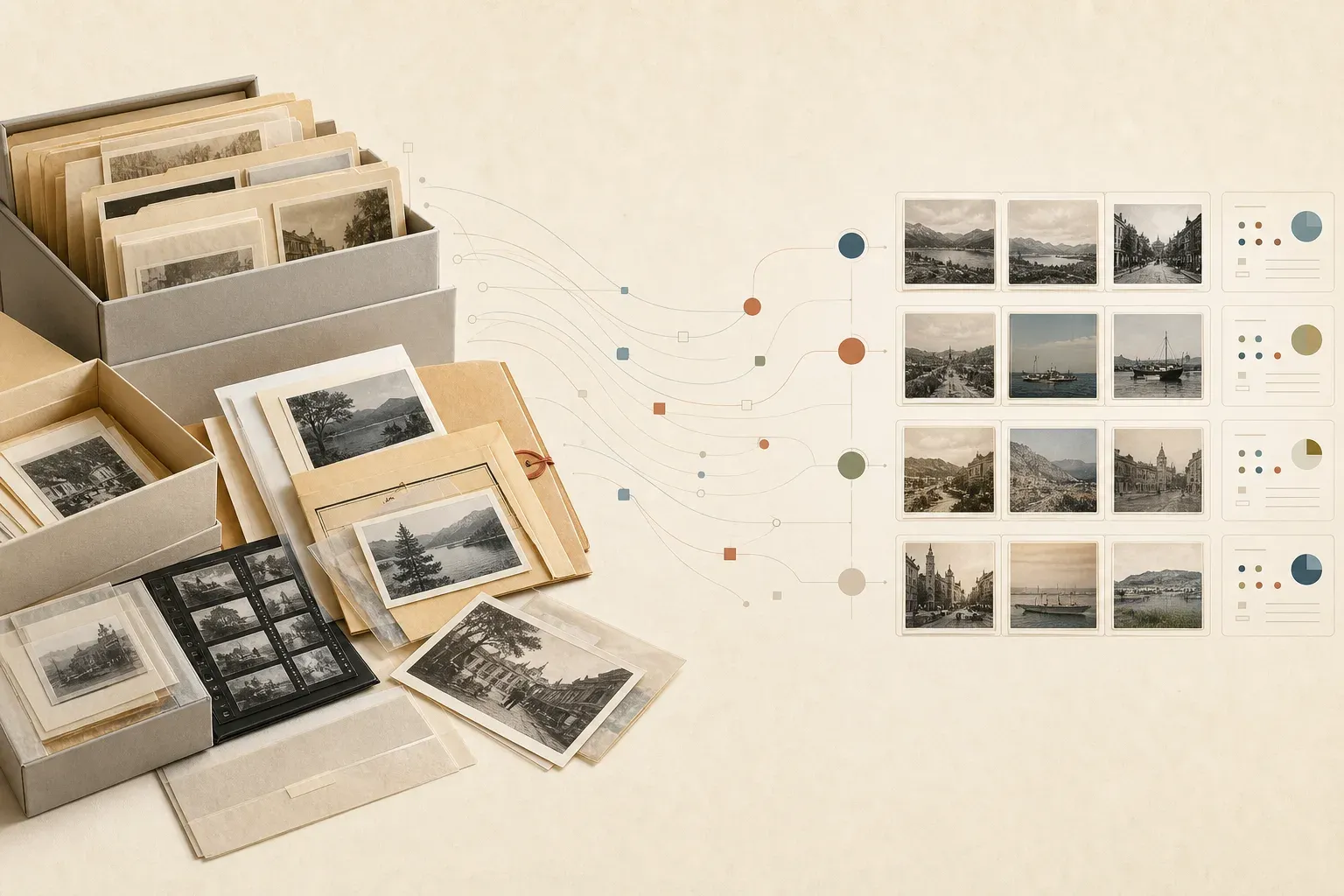
Many historical photo archives begin with the same problem: boxes, folders, envelopes, and hard drives full of images, but no reliable answer to a simple question: what do we actually have?
Some photographs have dates. Others have handwritten notes, vague filenames, or no context at all. Similar images may be stored in different places. A person who knows the collection may be the only link between the physical material and its history. Meanwhile, researchers, curators, and the public cannot discover what remains invisible.
The natural response is to catalog every photograph in detail. For most archives, that is not a realistic first step. A better approach is to make the collection visible in layers: establish a reliable inventory, add a useful first description, then deepen the cataloging where research and preservation needs justify it.
This is a practical workflow for archivists, catalogers, librarians, museums, historical societies, and small teams responsible for large photographic collections.
The first goal is discoverability, not perfect description
Archival description is valuable because it preserves context. It explains who created a record, how it came into the collection, what it relates to, and how it can be used. That context should not be replaced by a generic label or an automated guess.
At the same time, a collection does not need a finished item-level record for every photograph before it can become more useful. A collection-level view can already reveal its size, subjects, formats, periods, gaps, duplicates, and priorities.
The first goal is to move from an unknown collection to a searchable collection with clear levels of certainty. Detailed specialist description can follow where it adds the most value.
Why historical photo archives become difficult to catalog
Backlogs rarely come from one problem. They accumulate as collections grow faster than the time available to describe them.
Common sources of friction include:
- Information spread across boxes, spreadsheets, accession notes, and personal knowledge.
- Inconsistent names for people, places, events, and subjects.
- Photographs without dates, captions, or creator information.
- Multiple prints, scans, and near-duplicates of the same scene.
- Images stored in folders that reflect past working habits rather than the collection’s meaning.
- Different standards used by staff, volunteers, donors, or previous projects.
- Limited capacity for both digitization and description.
- Unclear rights, restrictions, or provenance.
These issues make it hard to decide what to process first. They also make a search box built around exact filenames far less useful than it appears.
Step 1: Create a collection-level inventory
Before asking a cataloger to describe every image, create a map of the collection. The inventory should answer practical questions:
- Which collections, accessions, boxes, folders, or digital batches exist?
- How many visual assets are in each group?
- What formats, orientations, and resolution categories are present?
- Which periods, places, subjects, and organizations appear to be represented?
- Where are the largest gaps in description?
- Which groups contain duplicates or repeated variants?
- Which material is most relevant to current research, exhibitions, or public requests?
This first layer does not need to settle every historical question. Its job is to give the team a reliable view of what exists and where further work will have the greatest impact.
Collection analytics can make this assessment faster. Visual and technical summaries can expose patterns that are difficult to see from a box list alone, such as dominant formats, image quality signals, repeated scenes, or groups that have very little descriptive context.
Where VisioClarity can help: use a workspace or collection as the scope for this first assessment, then review its collection analytics to see the visual and operational patterns that should shape your priorities.
Step 2: Establish a minimum discovery record
The minimum record should be useful to someone searching the collection and honest about what is not known. It can include:
- A short title or description.
- Collection, accession, box, folder, or batch context.
- Approximate date or date range when available.
- Place, event, organization, or subject when known.
- Creator or source when known.
- Rights and access information.
- A cataloging status.
- A confidence or review status for uncertain information.
The goal is not to create a universal schema. A press archive, museum collection, community archive, and university special collection will ask different questions. The metadata structure should reflect the way each institution needs to search, explain, and care for its material.
Templates and reusable field groups can provide a starting point without forcing every collection into the same model. A team can begin with a complete template, combine the fields it needs, or build a structure that reflects its own cataloging practice.
Where VisioClarity can help: create or adapt a metadata structure for the collection with Custom Fields, so the first discovery record can reflect archival context without requiring every institution to use the same schema.
Step 3: Use visual analysis for a first pass
Large image collections contain information that is difficult to capture manually at the beginning. Visual analysis can help create a first layer of discovery metadata by identifying patterns such as:
- Broad categories and visible objects.
- Dominant colors and image orientation.
- Similar images and likely duplicates.
- Technical properties and visual quality signals.
- Repeated locations, scenes, or compositions.
- Images that may belong to the same visual group.
Automated titles and descriptions can also help a team decide where human review should begin. This is most valuable as a triage mechanism, not as a substitute for archival interpretation.
An automated suggestion is not a confirmed historical fact. It should remain distinguishable from information supplied by a donor, found in a caption, verified by a specialist, or inferred from related records. Keeping those levels visible protects both the archive and the people who use it.
Where VisioClarity can help: process a batch of images to create a useful starting layer of visual metadata, then let catalogers review the results inside the collection rather than beginning with an entirely blank record.
Step 4: Catalog progressively, from broad context to detail
A practical workflow has at least two layers.
Layer one: collection discovery
This layer makes the collection visible quickly. It can describe broad subjects, visual characteristics, technical properties, likely relationships, and the location of each group within the archive.
Layer two: specialist description
This layer adds details that require historical knowledge or closer research:
- Confirmed identities and place names.
- Relationships between photographs.
- Provenance and acquisition history.
- Historical context and references.
- Conservation notes.
- Restrictions and reproduction information.
- Cross-references to related collections or records.
Progressive cataloging prevents the entire archive from waiting for the slowest level of description. It also gives specialists a better map for deciding where their expertise will have the greatest effect.
Where VisioClarity can help: keep the broad discovery layer in the same collection as the deeper metadata, folders, and asset details, so the team can move from overview to specialist review without splitting the library across separate systems.
Step 5: Design search around memory, not only filenames
Researchers rarely remember the exact filename assigned to a historical photograph. They may remember a harbor, a parade, a particular building, a family name, a season, or the visual feel of another image.
Useful discovery should combine:
- Natural-language search by meaning and visual intent.
- Image-reference search when a related photograph is available.
- Similar-image discovery for repeated scenes and variants.
- Metadata and custom fields for deliberate filtering.
- Facets for categories, objects, colors, formats, people, licenses, and visual characteristics.
This combination supports both exploratory and precise research. A cataloger can narrow a collection by date range and place, then inspect visually related results. A researcher can begin with a descriptive question, then refine the results using the information the archive has recorded.
Where VisioClarity can help: combine semantic text search, image references, similar-image discovery, and structured facets to support the different ways researchers and staff remember historical material.
Step 6: Make uncertainty visible
Historical collections often contain clues rather than definitive answers. A note on an envelope may conflict with a later spreadsheet. A location may be recognizable but not confirmed. A person may be identified by family knowledge but not yet supported by a source.
Add a simple status vocabulary to the workflow, such as:
- Suggested.
- Unconfirmed.
- Under review.
- Reviewed.
- Confirmed.
- Restricted.
- Needs research.
These statuses make the collection more useful without pretending that every field has the same authority. They also create a clear queue for the next cataloging pass.
Where VisioClarity can help: add review or certainty fields to the collection’s metadata structure, making provisional information visible and giving the team a consistent way to filter records that need research.
Step 7: Preserve provenance and rights as the collection becomes visible
Discoverability should not come at the expense of archival context. Keep the relationships that explain where an image came from and how it may be used.
Depending on the institution, this can include:
- Collection and accession relationships.
- Donor or creator information.
- Physical location and identifier.
- License or rights-holder information.
- Access restrictions.
- The source of a description.
- The date and status of a review.
These details give researchers a more responsible way to use the material and help staff make consistent decisions as the archive grows.
Where VisioClarity can help: keep license information, custom metadata, collection structure, and access segmentation connected to the asset library, so context remains part of everyday discovery and management.
A practical 30-day starting plan
An archive does not need to redesign every policy before it starts improving discoverability.
Week 1: define the scope
Select one collection or accession. Record what is already known, where the material lives, and which questions the team most often receives.
Week 2: define the minimum metadata
Choose the fields needed to identify, search, contextualize, and govern the collection. Separate confirmed information from provisional suggestions.
Week 3: process a representative sample
Review a sample that includes different periods, formats, subjects, and levels of disorder. Check whether the proposed structure and automated enrichment are useful for real cataloging work.
Week 4: publish the first discovery layer
Make the collection searchable internally or publicly according to its access rules. Record what remains unknown, what needs specialist attention, and which collection should be processed next.
The aim is to create a repeatable workflow, not to declare the backlog finished in a month.
What success should look like
The progress of a historical photo archive should not be measured only by the number of item-level records completed. Useful signals include:
- More of the collection has a visible, reliable description.
- Staff can retrieve images using more than filenames or folder paths.
- Duplicate groups and description gaps are easier to identify.
- Researchers can discover relevant material before requesting a manual lookup.
- Uncertain information is clearly marked for review.
- Knowledge no longer depends on a single staff member’s memory.
- Specialists can focus their time on the records where context matters most.
How VisioClarity supports historical photo archives
VisioClarity helps turn large image collections into structured, searchable, and actionable knowledge. Teams can combine automated image analysis, descriptive metadata, collection analytics, semantic and multimodal search, similar-image discovery, duplicate visualization, and custom metadata structures.
Workspaces, collections, folders, licenses, and access segmentation help preserve operational context while a library grows. Teams can use the first discovery layer to understand the collection, then deepen the description as research and cataloging progress.
The result is a practical path from hidden holdings to visual intelligence: understand what the archive contains, find the images that matter, and govern how their context and use are managed over time.
Frequently asked questions
Do I need to catalog every photograph before making an archive searchable?
No. A collection-level inventory and a reliable first layer of discovery metadata can make an archive useful while detailed item-level description continues. The important requirement is to make the level of description and any uncertainty clear.
Can automated image analysis replace an archivist?
No. It can help surface patterns, suggest descriptive metadata, identify duplicates, and prioritize review. Historical interpretation, provenance, rights, and confirmation still require people and institutional context.
What should I do with photographs that have no date or caption?
Record what is known, mark what is uncertain, and preserve the source of each clue. Approximate dates, possible locations, visual groupings, and review statuses can still make an image more discoverable without presenting an inference as a fact.
Where should a small archive begin?
Choose one representative collection, define a minimum metadata layer, and test the workflow against real search questions. Starting with a bounded collection creates evidence for the next priority and avoids waiting for a complete institution-wide redesign.
Make hidden collections discoverable
A historical photo archive becomes valuable when people can understand its scope, find what matters, and trust the context attached to each image. Perfect cataloging is a destination. Discoverability is the first step that makes the rest of the work possible.
Contact us to explore how VisioClarity can help turn a hidden image collection into visual intelligence.