
Cultural Heritage
How Visual Intelligence Complements AtoM and Omeka S
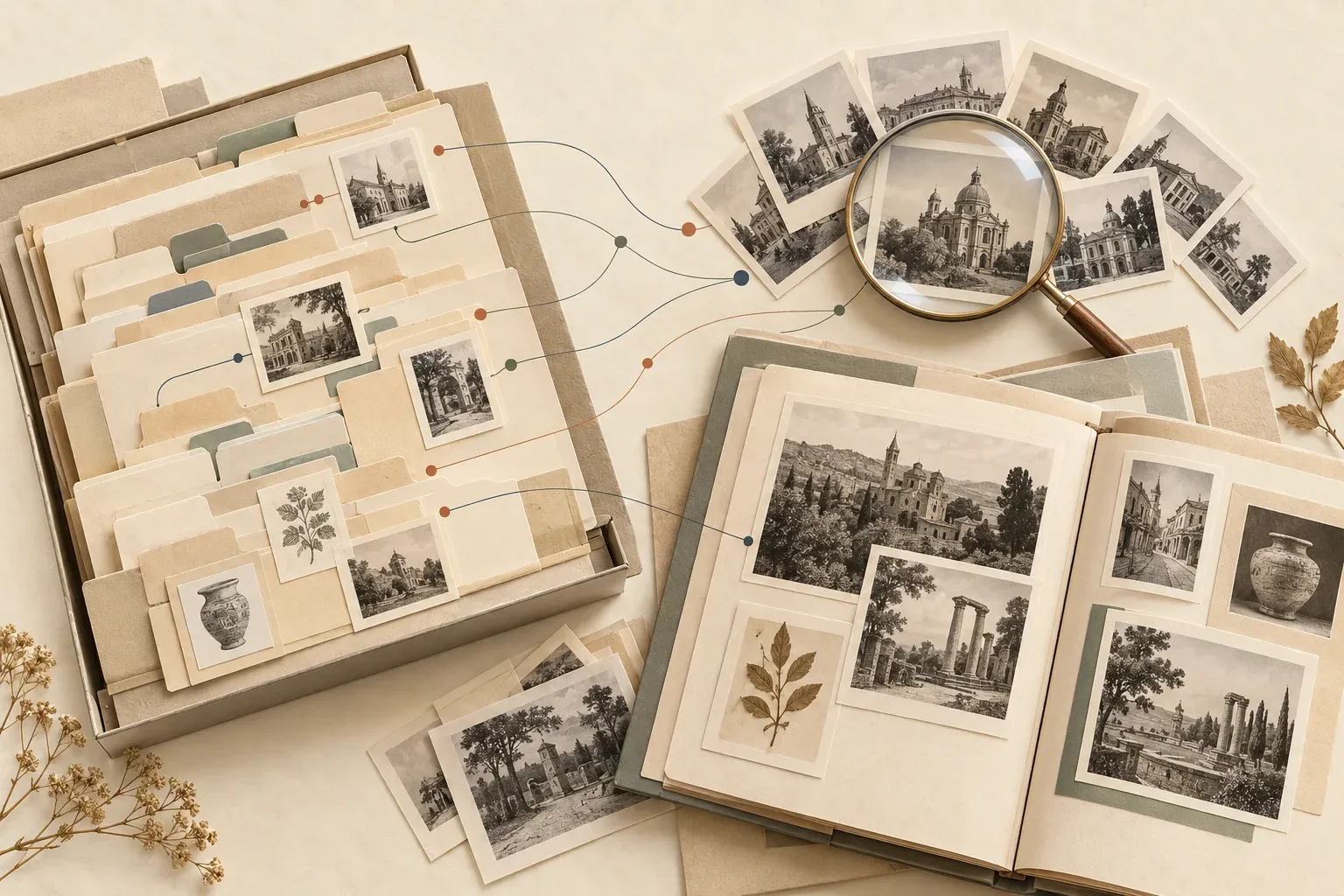
A cultural institution can have a carefully maintained catalogue and still struggle to answer a visual question: which photographs show a particular kind of workshop, building, landscape, or object when those features were never described?
The catalogue contains the institution’s knowledge. The images contain additional clues that may remain difficult to discover. Connecting those two layers makes a collection more useful to staff, researchers, and exhibition teams.
VisioClarity’s AtoM and Omeka S connectors bring visual intelligence into that relationship. They import images with catalogue context, return selected metadata after human review, and support integrated visual search linked to institutional records. The institution keeps its established descriptive and publishing environment while gaining another way to understand and explore its images.
This guide explains the diagnosis, the coexistence architecture, the division of responsibilities, and how to assess the institutional return on investment. The focus is visual search for cultural heritage collections: digitized images held by galleries, libraries, archives, and museums, collectively known as GLAM.
The diagnosis: a discovery gap in cultural archives
The gap appears when the visual content of a collection is richer than its searchable description. Digitization makes images accessible as files; useful discovery requires ways to connect what is visible with the context already recorded.
A photograph described as “Municipal works, undated” might show scaffolding, a tramline, shopfronts, and a distinctive bridge. Someone researching urban transport may never find it through those words. A curator may remember a composition but lack a title or reference code. Staff may recognize related scans only after opening them individually.
Typical symptoms include:
- Research requests depend on a colleague’s memory of the collection.
- Broad descriptions hide specific visible subjects.
- Similar images and duplicates are scattered across batches.
- Exhibition teams repeatedly browse folders to assemble candidates.
- Staff cannot see where enrichment would have the greatest value.
These problems can persist alongside good archival description. Collection context and visual subject matter answer different questions. A fonds description explains relationships and provenance; image analysis can help surface visible content within its digitized material.
For the broader cataloging workflow, see our guide to cataloging a historical photo archive when you do not know what you have.
AtoM and Omeka S serve different institutional roles
The right complementary layer depends on what the institution already manages. AtoM and Omeka S are useful examples because their primary responsibilities differ.
AtoM: archival description and context
AtoM is an open-source application for standards-based archival description and access in multilingual, multi-repository environments. Its strengths include descriptive standards, archival relationships, authority records, and metadata exchange. Those are central to maintaining the context that makes an archival record meaningful. AtoM project overview.
AtoM visual search should lead users back to the relevant description and its hierarchy. Finding a visually interesting photograph without its fonds, series, creator, or restrictions leaves the research task incomplete.
Omeka S: cultural publishing and connected resources
Omeka S is an institutional web publishing platform for digital cultural heritage. It supports multiple sites, linked open data, resource templates, and extensions through modules. It provides an environment for presenting collections and building interpretive experiences around them. Omeka S project overview.
Omeka S visual search can help staff select relevant images and help visitors explore permitted material through visual intent. Resource descriptions, exhibition narratives, and publishing decisions remain within the institution’s Omeka S workflow.
Neither product is universally the best software for every GLAM institution. ArchivesSpace supports archival information management, while CollectiveAccess offers configurable cataloging and publication for museum and archival collections. Institutions should also assess their existing modules and search configuration before adding another service.
The solution: a coexistence architecture
Coexistence gives each system a defined responsibility and connects them through stable references. The catalogue remains the authority for institutional description. VisioClarity provides image analysis, discovery, and collection intelligence.
The workflow has two paths:
- Discovery: catalogue context and images enter VisioClarity; visual search returns relevant images linked to the original records.
- Enrichment: analysis produces descriptive suggestions; staff review selected values; the connector returns approved metadata to designated catalogue fields.
The connector maintains the relationship between source records and visual assets. It does not require the institution to adopt a second competing catalogue. In practice, the team defines the collections, images, fields, and audiences covered by the connection.
An institutional record can correspond to several images, such as views of an object or pages of an album. Mapping must follow each system’s model: Omeka S items can carry media, while AtoM links one digital object to a description and uses lower-level descriptions for multiple objects. A shared parent context can therefore relate many images without flattening their individual records. AtoM digital-object documentation and Omeka S item documentation.
Preservation masters and preservation procedures remain under institutional control. Visual discovery complements that work; it does not establish a preservation repository or a retention policy.
Role matrix: who does what?
A successful connection separates automated assistance from institutional authority. The matrix below provides a practical starting point for assigning responsibilities.
| Responsibility | AtoM or Omeka S | VisioClarity | Institutional team |
|---|---|---|---|
| Authoritative description | Maintains institutional records and relationships | Keeps references and working context | Establishes standards and validates facts |
| Image understanding | Supplies connected images and descriptive context | Analyzes content, technical properties, and visual patterns | Interprets findings and identifies research priorities |
| Discovery | Provides catalogue navigation and record access | Adds semantic, image-reference, and multimodal search | Defines useful queries and evaluates relevance |
| Metadata enrichment | Receives selected reviewed fields | Generates descriptive suggestions | Accepts, edits, or rejects suggestions |
| Rights and access | Records institutional conditions and publication status | Supports licenses, metadata, and access segmentation | Determines permitted processing, access, and use |
| Public presentation | Holds the institutional description or publishing workflow | Supplies linked discovery results for the configured scope | Approves what becomes public |
| Operations | Maintains the existing application | Provides the visual intelligence service | IT manages the connection, mapping, and access configuration |
Archivists and catalogers own descriptive integrity. Curators shape interpretation and exhibition selection. IT maintains the connection. Collection managers coordinate priorities, access, and resources.
How the connectors work in everyday use
The AtoM and Omeka S connectors support three connected activities: importing a scoped collection, returning reviewed enrichment, and adding visual discovery to the catalogue experience.
Import images with their context
The connection brings selected images into VisioClarity together with identifiers, source-record references, and the metadata chosen for the collection. This makes a search result traceable to its institutional context.
Start with a defined collection and a field map. Useful fields may include a reference code, collection identifier, descriptive title, rights statement, review status, and source URL. The institution determines which are authoritative and which may receive enrichment.
The underlying systems provide documented interfaces: AtoM exposes its API through a plugin that must be enabled, and Omeka S provides a REST API. Supported operations and access depend on the installation. AtoM API overview and Omeka S REST API.
Return reviewed metadata
VisioClarity produces titles, descriptions, categories, and other image-level information. Staff review useful suggestions, correct them where necessary, and return selected values through the connector.
For cultural heritage metadata enrichment, keep the difference between “visible in the image” and “historically established” explicit. A description of a stone bridge may be useful; a proposed bridge name or construction date needs supporting evidence. Institutions can record the source and review status using their chosen metadata structure.
Search within the catalogue experience
Integrated search allows users to begin with natural language, an image reference, or text and an image together. Results connect to the original catalogue records so users can inspect context and access conditions.
The institution defines the permitted scope. Staff discovery and public discovery require separate access decisions; indexing an image does not make it suitable for publication. Review thumbnails, metadata visibility, and record links as well as full-image access when configuring each audience.
Understand, Find, Govern across a cultural collection
The value of visual intelligence extends beyond a search box. It connects an overview of the collection with discovery and operational context.
Understand: collection analytics reveal asset volumes, formats, resolution, visual characteristics, categories, objects, and duplicates. Staff can identify groups worth reviewing and assess the composition of the processed library. These signals support triage; a quality score does not determine cultural significance or conservation condition.
Find: semantic search supports descriptive queries, while image-reference search helps when a researcher has an example rather than a keyword. Metadata and facets narrow results by recorded context. Explore the capabilities in Visual Search.
Govern: custom fields, licenses, workspaces, collections, and access segmentation keep operational information connected to the images. The institution decides rights, restrictions, and publication. VisioClarity supports the working library without taking over those decisions.
This combination makes Visual Intelligence useful to teams that must both explore a collection and explain what their findings mean.
AtoM example: photographs hidden inside broad descriptions
Consider an illustrative municipal archive with photographs arranged by fonds and series. Records preserve acquisition history and context, but many item descriptions give little detail about visible scenes.
A researcher asks for images of markets with covered stalls. Staff select the relevant digitized collections through the AtoM connector, preserving description identifiers and parent context. They search with natural language, then use a promising photograph to inspect visually related images.
Each result leads back to its AtoM description. An archivist checks the series, known dates, captions, and access conditions before deciding which images answer the request. Similarity helps gather candidates; it does not prove that two photographs depict the same market or date.
Useful visual descriptions can then be reviewed and returned to designated fields. The catalogue gains detail without changing the provenance or arrangement. The institutional benefit is a repeatable route from an underdescribed photograph to an informed research response.
Omeka S example: building a digital exhibition
Consider an illustrative university collection preparing an exhibition about urban water infrastructure. Its Omeka S resources contain photographs, postcards, and object images, but subject terms vary across earlier projects.
The Omeka S connector brings the selected images and resource references into VisioClarity. Curators search for visual themes such as canals, pumps, bridges, and waterfront structures, combining descriptive queries with reference images and metadata filters.
Results provide candidates for comparison, each linked to its source item. One item may contain several image views; the team needs to know which view matched and how it relates to the whole resource.
Curators check historical context, rights, and exhibition relevance. Reviewed descriptions can be returned to selected properties, while narrative choices remain in Omeka S. Integrated public discovery can serve the permitted collection, according to the institution’s publishing configuration.
This expands the pool of discoverable material without claiming that automatic description can supply the exhibition’s historical argument.
Institutional benefits and return on investment
Return on investment should be measured through tasks the institution already performs. The most useful question is whether the connection improves discovery and releases staff capacity at a sustainable total cost.
Make routine work more efficient
Visual search can reduce repeated folder browsing and dependence on a particular colleague. Suggested metadata gives reviewers a starting point. Duplicate visualization helps locate copies, although deciding which file to retain still requires institutional judgment.
The time benefit is the difference between the previous workflow and the connected workflow, including review. Measure complete research or cataloging tasks rather than timing only the search response.
Increase the usefulness of existing collections
Discovering overlooked material can expand exhibition choices and improve responses to researchers. Collection analytics can help direct cataloging effort toward groups with useful visual content and weak description. These outcomes matter even when they do not produce direct revenue.
| Benefit | What to measure in a pilot | How to interpret it |
|---|---|---|
| Research support | Time to assemble a reviewed response | Include context and rights checking |
| Discovery coverage | Relevant images found across fixed questions | Check relevance, not just result volume |
| Cataloging assistance | Review time and accepted suggestions | Include corrections and rejected proposals |
| Collection understanding | Actionable priorities identified | Have collection staff validate usefulness |
| Sustainable cost | Subscription, setup, review, and maintenance | Compare against the complete existing workflow |
Build a credible cost case
Estimate the value of staff time released using measured task differences and the institution’s own cost assumptions. Compare it with subscription, configuration, onboarding, review, and maintenance costs. Keep that financial estimate separate from educational and research benefits, and avoid counting the same saved time twice.
There is no universal ROI percentage. A heavily used photo archive may benefit differently from a small, well-described collection. A pilot can also show that the existing search is sufficient, which is a useful purchasing outcome.
Scalability and why architectural efficiency matters
Scalability includes useful discovery, review capacity, and a budget the institution can sustain as digitization expands. Adding images should increase the value of the collection without creating a disproportionate platform burden.
VisioClarity’s architecture is optimized end to end for visual processing at scale. That efficiency supports broad image intelligence at a radically lower cost: semantic and visual search, analysis, enrichment, duplicate detection, and analytics are included in paid plans without separate AI credits or metered searches.
For an API-connected institutional workflow, Business includes API and MCP access at €399 per month, with 3 TB, 500,000 assets, and 30 administrators or editors. Enterprise supports custom requirements, including multi-million-asset libraries and large migrations. A Business capacity pack adds 1 TB and 200,000 assets for €79 per month. Check current plans and capacity.
Those are platform prices, not a promise that institutional setup has no cost. Include connector configuration, field mapping, hosting of the existing application, and staff review in procurement.
Customer assets are not used to train models, and VisioClarity storage and processing remain within the European Union. Institutions should assess which images and metadata are appropriate to process. For IT teams weighing an internal build, our visual search API build-versus-buy guide explains the ongoing engineering responsibilities involved.
Start with a representative collection
A bounded pilot provides better evidence than connecting the entire institution first. Choose images with varied descriptive quality, visual subjects, and access conditions.
- Record the baseline: collect recurring research questions and measure the current complete workflow.
- Define the map: agree on identifiers, source links, image relationships, fields, and permitted audiences.
- Connect and review: process the collection and inspect suggestions alongside trusted catalogue information.
- Test discovery: repeat the same questions with text, image references, and filters; evaluate relevant results.
- Test the return path: send selected reviewed metadata to designated fields and check the resulting records.
- Decide what to expand: assess usefulness, effort, cost, and remaining description gaps.
Use the pilot to agree on review responsibilities and an update process for records whose access or publication status changes. Expansion should follow the evidence from the collection.
Frequently asked questions
Does VisioClarity replace AtoM or Omeka S?
No. The connectors add visual analysis, reviewed metadata enrichment, and integrated search. The existing system continues to hold institutional description, context, and its established access or publishing workflow.
Can AI establish historical facts from a photograph?
Image analysis can surface visible content and suggest descriptions. Dates, locations, identities, provenance, and rights require evidence and human judgment. Visual similarity is a discovery signal, not proof of a historical relationship.
Does this apply to Omeka Classic?
This article covers Omeka S. Omeka Classic is a separate product, and its integration requirements must be evaluated separately. Do not assume the same connector or configuration applies.
Can a restricted image appear in public visual search?
Public search should cover only institutionally permitted material. Configure and test the audience scope, including previews, descriptions, and links. Staff access to an image does not imply public access.
Does VisioClarity process video and audio collections?
Current processing focuses on images. Video and audio processing are in development. Institutions whose main requirement is multimedia analysis should assess that distinction before selecting a workflow.
Make the catalogue’s images easier to discover
The institution has already invested in description, context, and publishing. Connecting that foundation with visual intelligence makes more of its digitized images usable for research and interpretation.
Review VisioClarity pricing for your capacity and integration needs, then start a trial with a representative collection. Use real questions and reviewed records to evaluate the value for your team.
Sources and verification date
Platform roles and API documentation were reviewed on 6 October 2026. These official sources document AtoM and Omeka S; they are not third-party endorsements of VisioClarity’s connectors. The examples above are illustrative workflows, not customer case studies.